Finished: February 24
Title: Saturn's Children
Author: Charles Stross
ISBN: 9780441015948
Binding: Hardcover
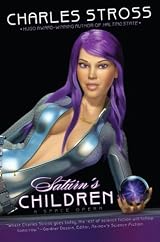 Let's just get this out of the way at the beginning. I'm so very very glad I read this one in hardcover, because that allowed me to remove the dust jacket and carry the book around in it's (ironically) less mortifying naked form. And if you think the cover is bad from the thumbnail to the left, let me assure you it's even worse when you're faced with the full wrap-around art that places a sexbot crotch on the spine of the book.
Yep, you read that right, sexbot. The main character of the book, Freya, is a humanoid robot designed for sex. Unfortunately, she was put in storage after construction and didn't get activated until around 100 years after the death of the last human being. This leaves her scrambling for other jobs in an attempt to both find purpose in "life" and keep from going into debt and getting slave-chipped, all the while facing the prejudices leveled against her due to her too-accurate humaniform shape. In a solar system where the robot aristocracy look like elves and chibi manga characters and the lowest classes are the machines that look like machines, Freya is decidedly lower middle class.
At the beginning of the book, she accidentally offends an aristocrat. The aristocrat's companions try to kill her. She runs, calls in favors, and gets off-planet. Someone tries to kill her again. She escapes and flees again, trying to figure out just what the heck is going on. Someone else makes her an offer she can't refuse, and she agrees to carry their package to yet another place in the solar system. All the while, she's learning more about the true purpose for which she and her "sisters" (the other models like her) were created and she keeps stumbling across evidence of opposing secret societies working for and against bringing back humanity from genetic samples.
A year or so ago, I read an interview with Stross in Locus about this book. He said that he'd grown up loving Heinlein novels and that he'd really wanted to write something like them, but that he kept running into a major problem in that human beings are just too damn fragile to go zooming around the solar system the way Heinlein and most other SF authors have 'em do. Either it takes years at a relatively slow speed to get somewhere, by which time the bones have turned to gelatin and cosmic rays have induced fatal cancer, or you go really really fast (probably using nuclear rockets, once again inducing fatal cancer or just frying the people outright) and quite likely pulp the people into red goo. Then he hit upon the solution. Robots! They don't really need air or food and are more resilient to both acceleration and radiation. And then he set to work.
If you've read Heinlein's Friday, you've read the identical cousin to this book. From the names - Freya and Friday - to several of the plot points - smuggling biologicals and the "not a real girl" mental anguish - Stross hits all the requisite targets. Heck, he even goes so far as to (purposefully) make Freya a redhead with nipples that go "spung!" (though in her case, it's due to a faulty overpressure valve). Little nods to other Heinlein works abound, as well. There's the Puppet Masters aspect of being slave-chipped. The ending of the book could be seen as a setup to a story like Orphans of the Sky or the Howard families diaspora in Methuselah's Children. Heinlein isn't the only one riffed, though. There are also references slipped in to writers such as John Scalzi and the Maltese Falcon even makes a brief appearance.
Overall, I liked this book. Stross manages a decent pastiche of Heinlein without crossing the line into outright parody. The little easter eggs tossed in did occasionally lead to me imagining Stross hunched over his keyboard giggling at his own cleverness, but that's more indicative of my flaws than of his and the references did not noticeably detract from my enjoyment of the book. Stross is not "The New Heinlein" any more than are John Varley (whose The Golden Globe may have provided inspiration for some of the details of Freya's trip from Venus to Mercury), Spider Robinson, or the aforementioned John Scalzi. What he is is a talented young writer having a great deal of fun and inviting us along for the ride. Plus, this was probably a good way give his brain a rest from dealing with the complexities of his Merchant Princes series.