Showing posts with label series. Show all posts

Sunday, May 17, 2009

Family problems

Read: March 5 through March 17, then finished post-honeymoon on April 2
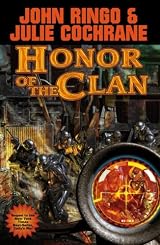
Title: Honor of the Clan
Authors: John Ringo & Julie Cochrane
ISBN: 9781416555919
Binding: Hardcover

Depending on where you look, this book is either the 7th or 10th book in Ringo's Legacy of the Aldenata series (which started back in 2000 with A Hymn Before Battle - you can read the first book free online) and it's definitely the 3rd book in the Cally's War spinoff series. Regardless, take it as given that there's a lot of backstory.

Short summary: An omnivorous and voracious species called the Posleen is spreading across space, eating everything it encounters. The Galactic Federation makes contact with humans and tells us that we're in the path of the oncoming horde and offers to help us if we'll just pledge ourselves to fighting the Posleen. Unfortunately, none of the member races of the Federation can actually help with the fighting bit because they've all been genetically uplifted in the far distant past by the meddling godlike hand of the Aldenata and violence is unthinkable to them (literally in the case of one of the species - they go berserk and die if their thoughts get too bloody). Therefore, it's up to good old humanity and our untrammeled aggression to save the day. Of course, some of the Galactics don't want to risk trading one dangerous species for another and so endeavor to make sure we conveniently extinct ourselves in the process of exterminating the Posleen.

By the time of Honor of the Clan, more than half a century after the beginning of the first book, the Posleen presence on Earth has been reduced in most places to scattered wandering ferals, but the human population is also much reduced. Billions died during the decades of war and Cally, one of the daughters of the main character of the first few books, is presumed to be among them. Instead, she went underground and is now one of the leaders of the human resistance against the Darhel. The Darhel are the administrators and bankers of the Galactic Federation. They're also the ones who sneakily tried to wipe us out (sneakily, because they're the ones whose noggins go pop if they too directly ponder killing*).

I'm not even going to attempt a plot summary here. Nobody should start reading the series with this book, because by the time you get to this point the plot threads are so convoluted that any new reader is going to immediately get lost. It doesn't help that new readers will have no idea who any of the characters are or why they should care. This is definitely a series that builds on previous books and rewards the faithful reader.

I have to admit that Ringo books are guilty pleasures for me. Even though I'm sometimes appalled by the politics and actions of many of his characters, the man can tell one hell of a rip-roaring story. That said, I am not directly recommending this particular book solely for the reasons listed in the previous paragraph. However, I am recommending that you start at the very beginning with A Hymn Before Battle (if you don't want to buy it, read it online) to see if you want to go any farther. Just be forewarned that the timbre of the series changes quite a bit with When the Devil Dances, completed after September 11th. Or, if you'd rather skip all the Starship Troopery goodness and get directly into the gritty cloak and daggery bits, you can start with the first book of the spinoff series, Cally's War.


*The Darhel inability to directly contemplate murder leads to a lot of verbal circumlocutions that would make any movie mobster proud. I don't have any examples in front of me at the moment, but there was quite a bit of the "He is becoming a problem that must be solved" and "Make him an offer he can't refuse" sort of stuff going on. No horse heads in beds, though.

Saturday, May 02, 2009

A Harry situation

It's been somewhere between two and three months since I read these. Let's hope I haven't forgotten too many details (or moved any bits of plot between volumes).

Read: February 2009
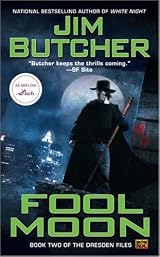
Title: Fool Moon (Book 2 of the Dresden Files)
Author: Jim Butcher
ISBN: 0451458125
Binding: Paperback

At the start of the second book, Harry has been called to a building under construction just outside of town to view a body apparently savaged by a large animal. He just has time to determine that the attacking animal appears to be somewhat but not exactly like a wolf when a group of FBI agents show up to take over the case and somewhat forcefully remind Murphy that she's a little out of her jurisdiction.

Of course, based on the title and the opening scene, I'm sure you've guessed that this book is all about werewolves. What you might not have guessed is just how many different types of were Butcher manages to cram in. As an incomplete list, he's got a pack of college kids who change back and forth with a magic spell, Hexenwolves who transform via magical artifacts given to them by some unnamed other, a Loup Garou cursed to turn into a ravening beast at the full moon, and Lycanthropes who retain their human shape but have souls filled with pure rage (as well as enhanced strength and healing and quite an appetite for blood - think viking berserker). Of course, Harry must bounce from one suspect to another - sometimes literally - as he tries to unravel the mystery of who or what is committing the murders and who or what stands to gain from the results. Oh, and I shouldn't forget to mention that Marcone, the big Mob boss who played a tangential role in the first book, gets much more time in the spotlight this time around.

There's still a good dose of the screaming stupids in this book. Not surprising, since it was published less than a year after the first one hit the bookstores (though it did take a few years for the first one to find a publisher, so the time spent writing the second couldn't have been all that compressed). My biggest pet peeves with this one are that Harry continues to knowingly do dumb and risky things and also continues to withhold crucial information from Murphy in order to "protect" her. Not surprisingly, this leads to a somewhat extreme lack of trust on Murphy's part which results in some of the bruises Harry picks up coming at her hands.

Overall, I rate this book on par or very slightly above the first book. Well-written fight scenes, but they fail to completely overcome the annoying characterizations.


Read: February 2009
Title: Grave Peril (Book 3 of the Dresden Files)
Author: Jim Butcher
ISBN: 0451458443
Binding: Paperback

This one opens with Harry and his long-time friend Added Character, er, Michael Carpenter racing to get to Cook County Hospital in time to stop a ghost from snuffing out the lives of every baby in the maternity ward. It seems that something has been stirring up Chicago's ectoplasmic population and Harry and Michael have had a rough week of ghostbusting.

Let's back up for a second and introduce this Michael guy properly. He's a holy Knight, carrying one of only three Swords containing a nail from the true Cross, and sent by the Creator to wherever he's most needed. He's also a contractor (making his last name all the more appropriate) and a family man with several children and a wife who really dislikes Harry. To be fair, she probably has a point, since Michael apparently winds up injured every time he and Harry work together.

Ok, back to the plot. During the battle with the supernatural suffocatrix, Harry figures out that she's probably going completely off the rails because someone has wrapped her in something like spiritual barbed-wire. Soon after, it's proven that the torture spell isn't just for the dearly departed when it hits some of Harry's acquaintances. This includes Murphy, taking her out of action for most of the rest of the book. Harry has to figure out who or what the Nightmare (as he calls the thing causing all the spectral distress) is, whether it's working for itself or for somebody else, and how to take it down before it achieves whatever it is it's working toward. This is further complicated when he's picked to be the representative of the White Council (think of it as the wizards' guild) to a kind of vampire* summit, being held at the home of a vampire he didn't really endear himself to back in the first book.

Of course, just about everything is interconnected somehow. Lots of screaming and large explosions ensue. As has become the norm, Harry gets the everliving shit kicked out of him more than once. And something very very bad happens to someone Harry cares about (in addition to the something merely very bad that happens to someone else). In the end, of course, Harry survives (as you might guess by the fourth book being reviewed below) - but things have gotten quite a bit more complicated and the scars he bears aren't just on his body.

The writing started to come together for me with this one. Apparently, it (in addition to Fool Moon and perhaps the fourth one as well) was already completed before the first one actually got published, but, in the words of Jim Butcher himself, "I had started putting together enough craft skills to overcome the lack of inborn talent." I admit I was thrown a bit by the way Michael was suddenly introduced in such a "I haven't mentioned him yet? But he's always been here!" kind of way. Butcher's explanation for this is that each book only really covers the absolute worst week of Harry's entire year because it's not really worth writing about the other eleven point something months when he's paying his bills by finding lost pets and spending his off hours at the drive-in movie. I guess I can accept that.

*Much like the weres in the second book, Butcher can't stop at just one type of vampire. He's got at least three, with hints of more. There's the Red Court, mentioned in the first book, that look like humans until they rip off their skins to reveal the slimy black batlike monstrosity beneath. Oh, and their spit is a powerfully addictive narcotic. Then there's the Black Court. Dracula was one of these. They're the undead ones with the power to turn into mist and a bad allergy to garlic. Apparently, Stoker wrote his book at the behest of the White Council as a kind of "how-to" guide on destroying the things. And then there's the White Court. They don't feed on blood. Instead, they subsist on emotions and life energy. Think "Sex Vampire."


Read: February 2009
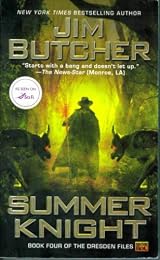
Title: Summer Knight (Book 4 of the Dresden Files)
Author: Jim Butcher
ISBN: 0451458923
Binding: Paperback

Harry's chilling at his office when a femme fatale straight out of a noir novel saunters in and promptly causes his blood to freeze. Not literally. Though she could. It's Queen Mab, the faerie queen of Winter, and she wants to hire him to clear her name. Someone has killed the Summer Knight, the mortal champion of the Summer Sidhe, and suspicion is falling on her. Even though Harry would love to tell her no, he takes the job because Mab has bought out his debt with his faerie godmother (don't think Cinderella, think more of the one that curses Sleeping Beauty). He has to either find or create proof of Mab's innocence before the Autumn Equinox, when power passes from the Summer Court to the Winter Court, or there will be a war that will likely send the Earth into another ice age.

As you might expect, someone doesn't want him digging into their business. In addition, the war between wizards and Red Court that Harry started in the last book continues to rage on and senior members of the White Council are seriously considering feeding his ass (perhaps literally) to the vampires as a peace gesture. This all leads to him having to dodge (or, at least, survive) attacks of all kinds as he travels through, above, and below Chicago in hopes of interviewing the various principals and suspects, including the three aspects of each of the courts - Lady, Queen, and Mother. My favorite bit is the attack in the garden section of WalMart by a plant monster. This is mainly because Harry insists on calling it a "chlorofiend" because, let's face it, you can't pick up chicks with daring tales of battling azaleas. I also greatly appreciated the reappearance of Toot-toot the pizza-loving fairy.

Harry does succeed in restoring the balance of power between the Seelie and Unseelie barely in time to avert the apocalypse. Just don't expect it to be a happily ever after sort of ending.

Of the first four, this one has faded most in my mind. Some of the sharpest memories of specific scenes stick with me, but the rest of the book has faded into the background a bit. Perhaps ironically, I consider this to be a good thing. It means the writing has improved to the point where it's getting out of my way. I remember so much of the first books because of the ways in which they annoyed me. The parts of the fourth book that are clearest to me are the parts that most delighted me (as those who witnessed my guffaws as I read it over several lunches in the breakroom at work could probably attest). This is the first one I actually feel like recommending.
Wednesday, April 15, 2009

Raindrops keep fallin' on my head...

Read: January 2009 (and review mostly written then, too)
Title: Storm Front (Book 1 of the Dresden Files)
Author: Jim Butcher
ISBN: 0451457811
Binding: Paperback

For years, several of my friends have exhorted me to read the Dresden Files novels. I finally gave in and I'm not sure if I'm sorry or not. Before I get into that, let me give you the background and plot summary.

Harry Blackstone Copperfield Dresden is a wizard in modern Chicago and, unlike virtually all of his brethren, he's not trying to hide it. In fact, he's gone so far as to open a business and advertise in the yellow pages. It's not a gig that pays well, since most people don't believe in magic and he refuses to make love potions or perform at kids' parties. Pretty much the only thing keeping him in beer and nachos is the occasional consultation job for the Special Investigations (ie, weird shit) unit of the Chicago PD. And this time, they have a doozy. A mob guy and a high-class escort have been found dead in a nearby hotel, their coitus interruptused when their hearts literally exploded out of their chests. He loses his lunch, but takes the job of figuring out what happened and who did it. Almost immediately after, he gets another job from a woman who wants him to find her missing husband (he doesn't figure it'll take long). Of course, both jobs are interconnected - as is the new drug that's hitting the streets, giving people second sight and consequently driving them completely insane.

Storm Front is Butcher's first published novel and I've been told it was created as an exercise in use of cliches for a writing class he was taking. Unfortunately, it shows. There's something you run into from time to time in books and movies (usually horror or thrillers) when the characters do something extremely dumb for the sole purpose of advancing the plot. They split up "to cover more ground" or go alone into the unlit basement or leave their weapons in another room, and what they're doing is so manifestly moronic that the reader or audience shouts imprecations at the book or screen. I call this "The Screaming Stupids", and Butcher's characters repeatedly suffer from 'em throughout the whole book. It doesn't really help a lot that the characters realize that they're about to do something dumb and then still go ahead and do it. If you're aware enough to have your main character think something like "this will probably kill me for no good reason", then you're aware enough to maybe come up with something that isn't the spiritual equivalent of having your character shave with a chainsaw because he doesn't want to admit he's run out of razor blades. Just for emphasis, AAAArrgh!

Regardless, the idea is interesting enough that I'll stick with it for at least a few more books. Hell, I kept reading Laurell K. Hamilton's Anita Blake books (pre sexy covers) up through Obsidian Butterfly before giving up. Also, I love Butcher's Codex Alera stuff, so I know his writing gets better with time. I just hope it happens soon.

Sunday, February 15, 2009

A smidge too far

Read: January 2009
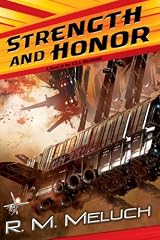
Title: Strength and Honor (Book 4 in the Voyage of the Merrimack series)
Author: R.M. Meluch
ISBN: 0756405270
Binding: Hardcover

This is the fourth book in a series. Here's the background as laid out in book one, The Myriad. In the not too far future, shortly after humanity begins colonizing the galaxy, the first colony to be founded declares independence and extends an invitation to all true children of Rome. Thousands of scientists, priests, doctors, and lawyers (but not indian chiefs, to my knowledge) drop what they're doing and emigrate. Rome never truly fell, you see. It just went underground, keeping itself clandestinely alive in those vocations and professions where Latin is spoken. A state of war develops between the United States and the rogue colony and things are spiraling downward until the discovery of a hive-like alien lifeform that eats anything organic forces the warring parties into an uneasy truce.

Over the first three books, we follow Captain John Faragut (of the Kentucky Faraguts) and the crew of the U.S. space battleship Merrimack as they fight the Romans, fight the Hive, fight (by which I mean outwit) the bureaucratic nitwits of the United Nations, fight the Hive some more, and in some cases fight their attraction to fellow servicemembers of the opposite sex. We also meet Augustus, a Roman patterner (think Frankenstein's monster with an implanted supercomputer) given to Faragut by Caesar to help (or possibly spy on) the Merrimack in its alien-fighting tasks. All in all, it's great brain-candy, full of little details (like hand-to-tentacle fighting against the hive gorgons by marines wielding swords because the gorgons emit a field that causes most technology to fail) that make the story a rip-roaring space opera of the highest caliber. There's even a giant pulsating temporal reset button in the first book that the author gets to press.

Then we get to book four. Since the end of the third book, it looks like it's pretty much all over but the shouting. The Hive appears to be vanquished, and little remains but for Merrimack to make the long journey home from the back end of beyond. Then (new) Caesar declares that since the threat is gone, the war is back on and simultaneously launches a bunch of sneak attacks. Augustus, still loyal to old Caesar (both because of programming and his own natural inclination), escapes and disappears. Merrimack heads for Earth at full speed. Treachery, subterfuge, fighting, insanity, yadda yadda yadda. Book ends.

Can you tell this one left me flat? Without the hive fighting from the previous books, the human-on-human ship battles were kinda cartoonish (in the old G.I. Joe fire a million laser rifles but nobody dies sense) because all the fighters and larger ships have such absurdly overpowered forcefields that they survive anything short of being plunged into the heart of the sun. The villains lack only pencil-thin mustaches to twirl and the heroes in at least a few cases actually do get to wear shining armor. The melodrama dial that was set to a nicely bubbling 7 or 8 in previous books gets cranked up to 11 in this one. The good guys win and get laid, the bad guys lose in horrific ways. It just felt to me that the author was tired of this series and wanted to tie off all the loose plot threads so she could bronze the whole ball of yarn and put it on her mantel.

Maybe I'm being too harsh. I don't know. However, I would have been happier if I'd either stopped when this was still a trilogy or if a much of the plot points in this book had been integrated earlier in the series. I recommend the first three books to those wanting a fun romp. However, I don't recommend Strength and Honor unless you really want to know what happens next or you've run out of other things to read. If you're craving some SFnal Romans, read Jim Butcher's Codex Alera books instead.

Thursday, February 12, 2009

Gated community

Read: January 2009
Title: Ptolemy's Gate
Author: Jonathan Stroud
ISBN: 0786818611
Binding: Hardcover

Another three years have passed and Mandrake, now seventeen, is in charge of the Information Ministry. This means he's responsible for, amongst other things, coming up with the propaganda leaflets used to tempt commoners into joining up to fight in the war against the rebel colonies in America. He has also kept Bartimaeus constantly summoned for nearly the entire time, partly to keep another magician from summoning the djinn and finding out Mandrake's true name and partly as a reminder of simpler times when he was only under constant threat of immediate horrible death. Unfortunately for Bartimaeus, extended presence in the material world is inimical to a demon's very essence and the poor fellow has been worn down to a nubbin and is barely able to maintain his shape, much less fight or do anything more energetic.

Our third major character, Kitty, has gone underground after the events of the second book and is living under a couple of assumed names. Under one of those names, she's become the commoner assistant to an old and eccentric magician who has undertaken to show her the rudiments of magic - in much the same way that one might decide to teach a pig to sing (ie, she's not really human and the attempt is likely doomed to failure, but it passes the time and the results might be amusing).

Not much can be said without giving away large plot points, but this is the book in which Mandrake/Nathaniel completes his hero's journey, catalyzed by meetings (chance and otherwise) with those he has admired or detested in previous books. We also get even more of Bartimaeus' personal history, Kitty makes a huge choice, and the diabolical mastermind who has stayed in the shadows throughout the trilogy unmasks just before all hell (or, at least, the demon world) breaks loose.

Highly inventive, very bittersweet, and lusciously detailed. I was sorry it had to end and I'd love to someday see a collection of short stories set throughout Bartimaeus' long long life. Recommended.

Oh! What big eyes you have!

Read: January 2009 (again)
Title: The Golem's Eye
Author: Jonathan Stroud
ISBN: 0786818603
Binding: Hardcover

It's been about two years since the end of the first book and Nathaniel, now operating under the use-name "John Mandrake", has secured both a new master and a high position in the security apparatus of the government. His job is to break the growing resistance movement, which appears to consist almost entirely of young commoners who've begun to develop the ability to resist or detect magic. Unfortunately, he's not making much progress and his superiors are beginning to eye him as a convenient scapegoat for their own lack of success. When something huge, dangerous, and apparently invisible and impervious to magic appears and begins to wreak havoc, Mandrake breaks a previous agreement and summons Bartimaeus again. Of course, all sorts of chaos ensues as Bartimaeus repeatedly just scrapes by the Golem (it's not a spoiler if it's in the title, is it?) and Mandrake bounces back and forth between London and Prague trying to gather enough evidence to prove the thing isn't just a figment of his imagination (and save his own skin in the process).

In this novel, in addition to the Mandrake and Bartimaeus story lines, much attention is paid to Kitty (briefly introduced in the first book) and her group of resistance fighters. For the most part the resistance doesn't really amount to much, mainly pilfering magic trinkets here and there in hopes of finding something they can use against the magicians.

The climax comes when the resistance group is hired by a mysterious stranger to steal some very powerful items from an extremely important magician's grave. Mandrake, Bartimaeus, and the Golem converge on the tomb at the same time, much to the detriment of virtually all involved.

Things I have not mentioned yet: Werewolves, ambulant skeletons, much more Bartimaeus backstory, skinny pants and trenchcoats, The Black Tumbler, and the dangers of angering your local print shop.

This is a great middle novel. It continues to flesh out the world, with more insights into the politics and history and the little touches that make a place feel lived-in. It advances the plot. It ends in a moderate cliffhanger to make you read the third book. Recommended.