When things are slow at work but I'm not able to get out to my section, I like to catch up on news from the book world at Publishers' Weekly. I've also become a fan of the Genreville and Shelftalker blogs hosted on the site.
Over the past few months, there have been several Shelftalker posts highlighting nifty places to drop a wad of cash on book-related products. In an attempt to spread the news a person or two further (and perhaps serendipitously glom a great gift) I'm collecting some of my favorites below.
1) Online galleries of book illustrations
Some of the art is gorgeous, some is disturbing, most of it is out of my price range. I might not be able to afford an original Mo Willems, but I can find some truly beautiful stuff (from an earlier, no-longer-under-copywrite time) at nocloo.com for under $30.
2) Book-related dishes
I like the Alice in Wonderland dishes, but I love the Memo line. How cool would it be to plot spaghetti parabolae on a graph-paper tray?
3) Literary Etsy
The personalized bookplates are awesome, though I wish they had some classic science fiction designs I could buy. I also like most of the prints in paperbones' shop, and they're very reasonably priced. However, my favorite item from this list has to be the book pillow.
Something the PW blogger didn't find, and probably my favorite overall, is this adorable print my fiance gave me for Christmas. It has hedgehogs in Scots Guards uniforms protecting a stack of books. That's a trifecta of win, and I couldn't possibly ask for anything more.
Saturday, February 21, 2009

Monday, February 16, 2009
A note on my writing style
I tend to use many asides. This can go too far.
(parenthetical (childrenhetical (just plain pathetic)))
(parenthetical (childrenhetical (just plain pathetic)))
It's a much cuter name than LCCN would've been
Read: January 2009
Title: Dewey, The Small-Town Library Cat Who Touched the World
Author: Vicki Myron (and Bret Witter)
ISBN: 9780446407410
Binding: Hardcover
 While opening the Spencer, Iowa public library on a frigid winter morning in the late 80s, Director Vicki Myron found a tiny frostbitten grey kitten huddled in the overnight book drop. Upon warming and washing the little animal, it was quickly discovered that he was actually a ginger tabby - and incredibly friendly to boot. He quickly became the mascot of first the library and eventually the whole town, gaining international recognition and drawing visitors from as far away as Japan during the almost 20 years of his reign as official Library Cat.
Perhaps Dewey is a little too anthropomorphized (he can read her mind, follows verbal directions, etc) and I could have done without as much backstory of the angst in Myron's personal life (married young to an alcoholic, had to have a hysterectomy due to an ob/gyn who induced labor so he could leave early for a party, etc), but I can live with all that if it means I get other tasty little snippets like the explanation of the history behind the town's architecture and the tale of the war of wits as the librarians try to keep Dewey from finding and eating their rubber bands. On the whole, this is a touching story of a woman and her cat which hits all the standard "animal memoir" plot points.
And yes, I cried a little at the end.
Title: Dewey, The Small-Town Library Cat Who Touched the World
Author: Vicki Myron (and Bret Witter)
ISBN: 9780446407410
Binding: Hardcover
While opening the Spencer, Iowa public library on a frigid winter morning in the late 80s, Director Vicki Myron found a tiny frostbitten grey kitten huddled in the overnight book drop. Upon warming and washing the little animal, it was quickly discovered that he was actually a ginger tabby - and incredibly friendly to boot. He quickly became the mascot of first the library and eventually the whole town, gaining international recognition and drawing visitors from as far away as Japan during the almost 20 years of his reign as official Library Cat.Perhaps Dewey is a little too anthropomorphized (he can read her mind, follows verbal directions, etc) and I could have done without as much backstory of the angst in Myron's personal life (married young to an alcoholic, had to have a hysterectomy due to an ob/gyn who induced labor so he could leave early for a party, etc), but I can live with all that if it means I get other tasty little snippets like the explanation of the history behind the town's architecture and the tale of the war of wits as the librarians try to keep Dewey from finding and eating their rubber bands. On the whole, this is a touching story of a woman and her cat which hits all the standard "animal memoir" plot points.
And yes, I cried a little at the end.
Sunday, February 15, 2009
A smidge too far
Read: January 2009
Title: Strength and Honor (Book 4 in the Voyage of the Merrimack series)
Author: R.M. Meluch
ISBN: 0756405270
Binding: Hardcover
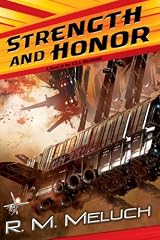 This is the fourth book in a series. Here's the background as laid out in book one, The Myriad. In the not too far future, shortly after humanity begins colonizing the galaxy, the first colony to be founded declares independence and extends an invitation to all true children of Rome. Thousands of scientists, priests, doctors, and lawyers (but not indian chiefs, to my knowledge) drop what they're doing and emigrate. Rome never truly fell, you see. It just went underground, keeping itself clandestinely alive in those vocations and professions where Latin is spoken. A state of war develops between the United States and the rogue colony and things are spiraling downward until the discovery of a hive-like alien lifeform that eats anything organic forces the warring parties into an uneasy truce.
Over the first three books, we follow Captain John Faragut (of the Kentucky Faraguts) and the crew of the U.S. space battleship Merrimack as they fight the Romans, fight the Hive, fight (by which I mean outwit) the bureaucratic nitwits of the United Nations, fight the Hive some more, and in some cases fight their attraction to fellow servicemembers of the opposite sex. We also meet Augustus, a Roman patterner (think Frankenstein's monster with an implanted supercomputer) given to Faragut by Caesar to help (or possibly spy on) the Merrimack in its alien-fighting tasks. All in all, it's great brain-candy, full of little details (like hand-to-tentacle fighting against the hive gorgons by marines wielding swords because the gorgons emit a field that causes most technology to fail) that make the story a rip-roaring space opera of the highest caliber. There's even a giant pulsating temporal reset button in the first book that the author gets to press.
Then we get to book four. Since the end of the third book, it looks like it's pretty much all over but the shouting. The Hive appears to be vanquished, and little remains but for Merrimack to make the long journey home from the back end of beyond. Then (new) Caesar declares that since the threat is gone, the war is back on and simultaneously launches a bunch of sneak attacks. Augustus, still loyal to old Caesar (both because of programming and his own natural inclination), escapes and disappears. Merrimack heads for Earth at full speed. Treachery, subterfuge, fighting, insanity, yadda yadda yadda. Book ends.
Can you tell this one left me flat? Without the hive fighting from the previous books, the human-on-human ship battles were kinda cartoonish (in the old G.I. Joe fire a million laser rifles but nobody dies sense) because all the fighters and larger ships have such absurdly overpowered forcefields that they survive anything short of being plunged into the heart of the sun. The villains lack only pencil-thin mustaches to twirl and the heroes in at least a few cases actually do get to wear shining armor. The melodrama dial that was set to a nicely bubbling 7 or 8 in previous books gets cranked up to 11 in this one. The good guys win and get laid, the bad guys lose in horrific ways. It just felt to me that the author was tired of this series and wanted to tie off all the loose plot threads so she could bronze the whole ball of yarn and put it on her mantel.
Maybe I'm being too harsh. I don't know. However, I would have been happier if I'd either stopped when this was still a trilogy or if a much of the plot points in this book had been integrated earlier in the series. I recommend the first three books to those wanting a fun romp. However, I don't recommend Strength and Honor unless you really want to know what happens next or you've run out of other things to read. If you're craving some SFnal Romans, read Jim Butcher's Codex Alera books instead.
Title: Strength and Honor (Book 4 in the Voyage of the Merrimack series)
Author: R.M. Meluch
ISBN: 0756405270
Binding: Hardcover
This is the fourth book in a series. Here's the background as laid out in book one, The Myriad. In the not too far future, shortly after humanity begins colonizing the galaxy, the first colony to be founded declares independence and extends an invitation to all true children of Rome. Thousands of scientists, priests, doctors, and lawyers (but not indian chiefs, to my knowledge) drop what they're doing and emigrate. Rome never truly fell, you see. It just went underground, keeping itself clandestinely alive in those vocations and professions where Latin is spoken. A state of war develops between the United States and the rogue colony and things are spiraling downward until the discovery of a hive-like alien lifeform that eats anything organic forces the warring parties into an uneasy truce.Over the first three books, we follow Captain John Faragut (of the Kentucky Faraguts) and the crew of the U.S. space battleship Merrimack as they fight the Romans, fight the Hive, fight (by which I mean outwit) the bureaucratic nitwits of the United Nations, fight the Hive some more, and in some cases fight their attraction to fellow servicemembers of the opposite sex. We also meet Augustus, a Roman patterner (think Frankenstein's monster with an implanted supercomputer) given to Faragut by Caesar to help (or possibly spy on) the Merrimack in its alien-fighting tasks. All in all, it's great brain-candy, full of little details (like hand-to-tentacle fighting against the hive gorgons by marines wielding swords because the gorgons emit a field that causes most technology to fail) that make the story a rip-roaring space opera of the highest caliber. There's even a giant pulsating temporal reset button in the first book that the author gets to press.
Then we get to book four. Since the end of the third book, it looks like it's pretty much all over but the shouting. The Hive appears to be vanquished, and little remains but for Merrimack to make the long journey home from the back end of beyond. Then (new) Caesar declares that since the threat is gone, the war is back on and simultaneously launches a bunch of sneak attacks. Augustus, still loyal to old Caesar (both because of programming and his own natural inclination), escapes and disappears. Merrimack heads for Earth at full speed. Treachery, subterfuge, fighting, insanity, yadda yadda yadda. Book ends.
Can you tell this one left me flat? Without the hive fighting from the previous books, the human-on-human ship battles were kinda cartoonish (in the old G.I. Joe fire a million laser rifles but nobody dies sense) because all the fighters and larger ships have such absurdly overpowered forcefields that they survive anything short of being plunged into the heart of the sun. The villains lack only pencil-thin mustaches to twirl and the heroes in at least a few cases actually do get to wear shining armor. The melodrama dial that was set to a nicely bubbling 7 or 8 in previous books gets cranked up to 11 in this one. The good guys win and get laid, the bad guys lose in horrific ways. It just felt to me that the author was tired of this series and wanted to tie off all the loose plot threads so she could bronze the whole ball of yarn and put it on her mantel.
Maybe I'm being too harsh. I don't know. However, I would have been happier if I'd either stopped when this was still a trilogy or if a much of the plot points in this book had been integrated earlier in the series. I recommend the first three books to those wanting a fun romp. However, I don't recommend Strength and Honor unless you really want to know what happens next or you've run out of other things to read. If you're craving some SFnal Romans, read Jim Butcher's Codex Alera books instead.
Thursday, February 12, 2009
The sincerest form of flattery
Occasionally, when browsing the shelves of one of my local bookstores, I'll come across something that looks just a wee bit familiar. A few months ago (shortly after I started carrying around a small notebook for other reasons), I started jotting down titles so I could present them to you, my faithful reader. Yes, I know I may be talking only to myself.
First up, animal cutouts:
Next, blurry secrets:
And barcode mascara:
Finally, can you say "road trip":
Have you seen any more like this?
First up, animal cutouts:
 |  |
Next, blurry secrets:
 |  |
And barcode mascara:
 |  |
Finally, can you say "road trip":
 |  |
Have you seen any more like this?
Gated community
Read: January 2009
Title: Ptolemy's Gate
Author: Jonathan Stroud
ISBN: 0786818611
Binding: Hardcover
 Another three years have passed and Mandrake, now seventeen, is in charge of the Information Ministry. This means he's responsible for, amongst other things, coming up with the propaganda leaflets used to tempt commoners into joining up to fight in the war against the rebel colonies in America. He has also kept Bartimaeus constantly summoned for nearly the entire time, partly to keep another magician from summoning the djinn and finding out Mandrake's true name and partly as a reminder of simpler times when he was only under constant threat of immediate horrible death. Unfortunately for Bartimaeus, extended presence in the material world is inimical to a demon's very essence and the poor fellow has been worn down to a nubbin and is barely able to maintain his shape, much less fight or do anything more energetic.
Our third major character, Kitty, has gone underground after the events of the second book and is living under a couple of assumed names. Under one of those names, she's become the commoner assistant to an old and eccentric magician who has undertaken to show her the rudiments of magic - in much the same way that one might decide to teach a pig to sing (ie, she's not really human and the attempt is likely doomed to failure, but it passes the time and the results might be amusing).
Not much can be said without giving away large plot points, but this is the book in which Mandrake/Nathaniel completes his hero's journey, catalyzed by meetings (chance and otherwise) with those he has admired or detested in previous books. We also get even more of Bartimaeus' personal history, Kitty makes a huge choice, and the diabolical mastermind who has stayed in the shadows throughout the trilogy unmasks just before all hell (or, at least, the demon world) breaks loose.
Highly inventive, very bittersweet, and lusciously detailed. I was sorry it had to end and I'd love to someday see a collection of short stories set throughout Bartimaeus' long long life. Recommended.
Title: Ptolemy's Gate
Author: Jonathan Stroud
ISBN: 0786818611
Binding: Hardcover
Our third major character, Kitty, has gone underground after the events of the second book and is living under a couple of assumed names. Under one of those names, she's become the commoner assistant to an old and eccentric magician who has undertaken to show her the rudiments of magic - in much the same way that one might decide to teach a pig to sing (ie, she's not really human and the attempt is likely doomed to failure, but it passes the time and the results might be amusing).
Not much can be said without giving away large plot points, but this is the book in which Mandrake/Nathaniel completes his hero's journey, catalyzed by meetings (chance and otherwise) with those he has admired or detested in previous books. We also get even more of Bartimaeus' personal history, Kitty makes a huge choice, and the diabolical mastermind who has stayed in the shadows throughout the trilogy unmasks just before all hell (or, at least, the demon world) breaks loose.
Highly inventive, very bittersweet, and lusciously detailed. I was sorry it had to end and I'd love to someday see a collection of short stories set throughout Bartimaeus' long long life. Recommended.
Oh! What big eyes you have!
Read: January 2009 (again)
Title: The Golem's Eye
Author: Jonathan Stroud
ISBN: 0786818603
Binding: Hardcover
 It's been about two years since the end of the first book and Nathaniel, now operating under the use-name "John Mandrake", has secured both a new master and a high position in the security apparatus of the government. His job is to break the growing resistance movement, which appears to consist almost entirely of young commoners who've begun to develop the ability to resist or detect magic. Unfortunately, he's not making much progress and his superiors are beginning to eye him as a convenient scapegoat for their own lack of success. When something huge, dangerous, and apparently invisible and impervious to magic appears and begins to wreak havoc, Mandrake breaks a previous agreement and summons Bartimaeus again. Of course, all sorts of chaos ensues as Bartimaeus repeatedly just scrapes by the Golem (it's not a spoiler if it's in the title, is it?) and Mandrake bounces back and forth between London and Prague trying to gather enough evidence to prove the thing isn't just a figment of his imagination (and save his own skin in the process).
In this novel, in addition to the Mandrake and Bartimaeus story lines, much attention is paid to Kitty (briefly introduced in the first book) and her group of resistance fighters. For the most part the resistance doesn't really amount to much, mainly pilfering magic trinkets here and there in hopes of finding something they can use against the magicians.
The climax comes when the resistance group is hired by a mysterious stranger to steal some very powerful items from an extremely important magician's grave. Mandrake, Bartimaeus, and the Golem converge on the tomb at the same time, much to the detriment of virtually all involved.
Things I have not mentioned yet: Werewolves, ambulant skeletons, much more Bartimaeus backstory, skinny pants and trenchcoats, The Black Tumbler, and the dangers of angering your local print shop.
This is a great middle novel. It continues to flesh out the world, with more insights into the politics and history and the little touches that make a place feel lived-in. It advances the plot. It ends in a moderate cliffhanger to make you read the third book. Recommended.
Title: The Golem's Eye
Author: Jonathan Stroud
ISBN: 0786818603
Binding: Hardcover
In this novel, in addition to the Mandrake and Bartimaeus story lines, much attention is paid to Kitty (briefly introduced in the first book) and her group of resistance fighters. For the most part the resistance doesn't really amount to much, mainly pilfering magic trinkets here and there in hopes of finding something they can use against the magicians.
The climax comes when the resistance group is hired by a mysterious stranger to steal some very powerful items from an extremely important magician's grave. Mandrake, Bartimaeus, and the Golem converge on the tomb at the same time, much to the detriment of virtually all involved.
Things I have not mentioned yet: Werewolves, ambulant skeletons, much more Bartimaeus backstory, skinny pants and trenchcoats, The Black Tumbler, and the dangers of angering your local print shop.
This is a great middle novel. It continues to flesh out the world, with more insights into the politics and history and the little touches that make a place feel lived-in. It advances the plot. It ends in a moderate cliffhanger to make you read the third book. Recommended.
Wednesday, February 04, 2009
Djinni & Ifrits & Imps, Oh My!
Read: January 2009 (again)
Title: The Amulet of Samarkand
Author: Jonathan Stroud
ISBN: 0786852550
Binding: Hardcover
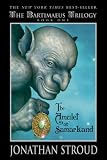 When first we meet the main human character, it is through the eyes of Bartimaeus, a demon (of the djinn variety, more powerful than imps and foliots but less so than ifrits and marids) summoned for the express purpose of stealing the title object from a renowned magician in vengeance for a humiliation recently suffered at the hands (at least, by proxy) of that magician. The impression is not a positive one. The summoner is a mere boy of no more than 12 years of age, gangly and greasy and puffed up with pride and ambition. Bartimaeus unwillingly (since most anything a demon does for its master is not done willingly) does as he is told, with unintended and somewhat disastrous consequences, and the plot rolls quite robustly along.
The story alternates chapters between Bartimaeus' first person POV and third person narration about Nathaniel (for that is the boy's name). We learn that Bartimaeus has been around for a couple of thousand years, has been summoned by the likes of Ptolemy and Solomon (though honestly, what demon didn't meet Solomon at least once), and is still around mainly due to his wit (which he's quite proud of) and a certain tendency to slope off rather quickly when the going gets rough. We learn that Nathaniel has been apprenticed to his master since around the age of six, knows quite a bit more about magic than his rather mediocre mentor might suspect (due to a voracious appetite for the books in his master's study), and really should not have gotten into the habit of letting his master's wife call him by his given name. True names have a power, you see, and as soon as Bartimaeus stumbles upon Nathaniel's, the shoe is on the other foot... or cloven hoof... or whatever.
The true joy in this book for me was the marvelous world-building. It's set more or less in modern-day England, mostly in and around London, but the level of technology hovers around the early 1940s (don't need much science when you've got the occult) and there's a very 1984 vibe in the air. Magicians have controlled the entire apparatus of government since the great magician Gladstone became Prime Minister about 150 years ago and commoners (ie, nonmagicians) are very much second class citizens, existing at the whim of forces they can't control and don't understand. One particular detail I noted was the heavy use of search spheres, mystical orbs that roam about transmitting images and sound back to a central location, to literally keep an eye on the populace. The parallels between this and the real-life ubiquity of CCTV cameras in modern Great Britain are pretty striking.
This is the first book in a trilogy so you know the main characters survive, though others are not so lucky. This doesn't keep them from having a few close scrapes. Overall, the level of action in this book stays pretty high and you find yourself rooting for Bartimaeus and Nathaniel throughout (though Nathaniel could doubtless profit from a good bit of ego deflation - a task Bartimaeus undertakes with great gusto). I had first read this book five or more years ago and I enjoyed this second reading just as much if not more so.
Recommended.
Title: The Amulet of Samarkand
Author: Jonathan Stroud
ISBN: 0786852550
Binding: Hardcover
When first we meet the main human character, it is through the eyes of Bartimaeus, a demon (of the djinn variety, more powerful than imps and foliots but less so than ifrits and marids) summoned for the express purpose of stealing the title object from a renowned magician in vengeance for a humiliation recently suffered at the hands (at least, by proxy) of that magician. The impression is not a positive one. The summoner is a mere boy of no more than 12 years of age, gangly and greasy and puffed up with pride and ambition. Bartimaeus unwillingly (since most anything a demon does for its master is not done willingly) does as he is told, with unintended and somewhat disastrous consequences, and the plot rolls quite robustly along. The story alternates chapters between Bartimaeus' first person POV and third person narration about Nathaniel (for that is the boy's name). We learn that Bartimaeus has been around for a couple of thousand years, has been summoned by the likes of Ptolemy and Solomon (though honestly, what demon didn't meet Solomon at least once), and is still around mainly due to his wit (which he's quite proud of) and a certain tendency to slope off rather quickly when the going gets rough. We learn that Nathaniel has been apprenticed to his master since around the age of six, knows quite a bit more about magic than his rather mediocre mentor might suspect (due to a voracious appetite for the books in his master's study), and really should not have gotten into the habit of letting his master's wife call him by his given name. True names have a power, you see, and as soon as Bartimaeus stumbles upon Nathaniel's, the shoe is on the other foot... or cloven hoof... or whatever.
The true joy in this book for me was the marvelous world-building. It's set more or less in modern-day England, mostly in and around London, but the level of technology hovers around the early 1940s (don't need much science when you've got the occult) and there's a very 1984 vibe in the air. Magicians have controlled the entire apparatus of government since the great magician Gladstone became Prime Minister about 150 years ago and commoners (ie, nonmagicians) are very much second class citizens, existing at the whim of forces they can't control and don't understand. One particular detail I noted was the heavy use of search spheres, mystical orbs that roam about transmitting images and sound back to a central location, to literally keep an eye on the populace. The parallels between this and the real-life ubiquity of CCTV cameras in modern Great Britain are pretty striking.
This is the first book in a trilogy so you know the main characters survive, though others are not so lucky. This doesn't keep them from having a few close scrapes. Overall, the level of action in this book stays pretty high and you find yourself rooting for Bartimaeus and Nathaniel throughout (though Nathaniel could doubtless profit from a good bit of ego deflation - a task Bartimaeus undertakes with great gusto). I had first read this book five or more years ago and I enjoyed this second reading just as much if not more so.
Recommended.
Subscribe to:
Posts (Atom)