Showing posts with label science fiction. Show all posts

Sunday, May 17, 2009

Family problems

Read: March 5 through March 17, then finished post-honeymoon on April 2
Title: Honor of the Clan
Authors: John Ringo & Julie Cochrane
ISBN: 9781416555919
Binding: Hardcover
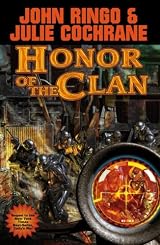
Depending on where you look, this book is either the 7th or 10th book in Ringo's Legacy of the Aldenata series (which started back in 2000 with A Hymn Before Battle - you can read the first book free online) and it's definitely the 3rd book in the Cally's War spinoff series. Regardless, take it as given that there's a lot of backstory.

Short summary: An omnivorous and voracious species called the Posleen is spreading across space, eating everything it encounters. The Galactic Federation makes contact with humans and tells us that we're in the path of the oncoming horde and offers to help us if we'll just pledge ourselves to fighting the Posleen. Unfortunately, none of the member races of the Federation can actually help with the fighting bit because they've all been genetically uplifted in the far distant past by the meddling godlike hand of the Aldenata and violence is unthinkable to them (literally in the case of one of the species - they go berserk and die if their thoughts get too bloody). Therefore, it's up to good old humanity and our untrammeled aggression to save the day. Of course, some of the Galactics don't want to risk trading one dangerous species for another and so endeavor to make sure we conveniently extinct ourselves in the process of exterminating the Posleen.

By the time of Honor of the Clan, more than half a century after the beginning of the first book, the Posleen presence on Earth has been reduced in most places to scattered wandering ferals, but the human population is also much reduced. Billions died during the decades of war and Cally, one of the daughters of the main character of the first few books, is presumed to be among them. Instead, she went underground and is now one of the leaders of the human resistance against the Darhel. The Darhel are the administrators and bankers of the Galactic Federation. They're also the ones who sneakily tried to wipe us out (sneakily, because they're the ones whose noggins go pop if they too directly ponder killing*).

I'm not even going to attempt a plot summary here. Nobody should start reading the series with this book, because by the time you get to this point the plot threads are so convoluted that any new reader is going to immediately get lost. It doesn't help that new readers will have no idea who any of the characters are or why they should care. This is definitely a series that builds on previous books and rewards the faithful reader.

I have to admit that Ringo books are guilty pleasures for me. Even though I'm sometimes appalled by the politics and actions of many of his characters, the man can tell one hell of a rip-roaring story. That said, I am not directly recommending this particular book solely for the reasons listed in the previous paragraph. However, I am recommending that you start at the very beginning with A Hymn Before Battle (if you don't want to buy it, read it online) to see if you want to go any farther. Just be forewarned that the timbre of the series changes quite a bit with When the Devil Dances, completed after September 11th. Or, if you'd rather skip all the Starship Troopery goodness and get directly into the gritty cloak and daggery bits, you can start with the first book of the spinoff series, Cally's War.


*The Darhel inability to directly contemplate murder leads to a lot of verbal circumlocutions that would make any movie mobster proud. I don't have any examples in front of me at the moment, but there was quite a bit of the "He is becoming a problem that must be solved" and "Make him an offer he can't refuse" sort of stuff going on. No horse heads in beds, though.

Friday, May 15, 2009

It's not Occam's Razor

Started: February 22
Finished: March 4
Title: Lucy's Blade
Author: John Lambshead
ISBN: 9781416555773
Binding: Mass Market Paperback

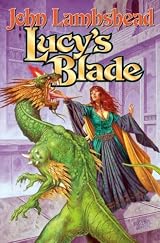
Yet another bad cover! The woman depicted is supposed to be a sixteen year old girl in Elizabethan England. Granted, she's sharing her body with a being of pure energy from the far future (or perhaps a parallel dimension), but that still doesn't explain the ridiculous rack. Must be an example of "most common superpower". It's become egregious enough with most books published by Baen that I've begun thinking of the publishers name as being an acronym for Boobs Adorn Each Novel.

This book mostly takes place in the Elizabethan era, but also features both a few modern-day or near future scenes and one bit set in the unimaginably far future. In the more or less now, a woman working (or compelled to work for) a shadowy organization steals a chest from an archeological dig and then, against orders, opens the chest and is hypnotized by the enormous diamond inside. We'll call this the wrapper story, as the book is written somewhat as though the tale is being told to her.

In the short bit set in the distant future, an intelligence is created for the sole purpose of being flung into the past (or across the dimensions) to search for the genesis of her people. It appears that there's a religious schism in the works between those that believe the energy beings descended from or were created by organic life and those that believe they arose naturally or in some way unrelated to the organics. The young intelligence successfully lands in the more or less modern day, colonizes the internet, and sucks up all the information she can lay her mind on. Just as she's getting ready to jump back home (likely causing every computer on the planet to crash in the process), she's grabbed by an unknown force and dragged further into the past, where she is caught first by one demon summoner and then by another. The latter summoner is working for Queen Elizabeth's head spy, Sir Francis Walsingham. Unfortunately, Walsingham's niece breaks the summoning circle and the energy being enters her. This has the beneficial effect of basically turning Lucy into something very like Buffy the Vampire Slayer, but means that Lilith (a name the energy being picked up from the first summoner) can't leave without killing her.

Of course, it turns out that the first summoner is working with people trying to assassinate the queen. Lucy, with her new powers and the help of Lilith's vast intellect, jumps into the fray to help foil the plot. A series of adventures occur. At the end of the book, the current-day lady awakes from her diamond-bedazzled daze in possession of immensely important knowledge and also in great danger. A sequel appears assured, probably focused on sleepy-gal.

This appears to be a first novel (the only other things I can find under the author's name are a few Warhammer game supplements), but it reads well. My only real quibble is that the book sometimes feels like a collection of short stories stitched together with bridging text. I'm not going to force this one on all my friends and family, but I do plan on reading any other books Lambshead comes out with (as long as they aren't more sourcebooks for a game I don't play).

Thursday, May 14, 2009

TGIF

Started: February 21
Finished: February 24
Title: Saturn's Children
Author: Charles Stross
ISBN: 9780441015948
Binding: Hardcover

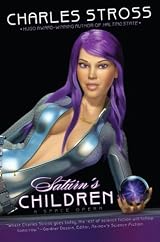
Let's just get this out of the way at the beginning. I'm so very very glad I read this one in hardcover, because that allowed me to remove the dust jacket and carry the book around in it's (ironically) less mortifying naked form. And if you think the cover is bad from the thumbnail to the left, let me assure you it's even worse when you're faced with the full wrap-around art that places a sexbot crotch on the spine of the book.

Yep, you read that right, sexbot. The main character of the book, Freya, is a humanoid robot designed for sex. Unfortunately, she was put in storage after construction and didn't get activated until around 100 years after the death of the last human being. This leaves her scrambling for other jobs in an attempt to both find purpose in "life" and keep from going into debt and getting slave-chipped, all the while facing the prejudices leveled against her due to her too-accurate humaniform shape. In a solar system where the robot aristocracy look like elves and chibi manga characters and the lowest classes are the machines that look like machines, Freya is decidedly lower middle class.

At the beginning of the book, she accidentally offends an aristocrat. The aristocrat's companions try to kill her. She runs, calls in favors, and gets off-planet. Someone tries to kill her again. She escapes and flees again, trying to figure out just what the heck is going on. Someone else makes her an offer she can't refuse, and she agrees to carry their package to yet another place in the solar system. All the while, she's learning more about the true purpose for which she and her "sisters" (the other models like her) were created and she keeps stumbling across evidence of opposing secret societies working for and against bringing back humanity from genetic samples.

A year or so ago, I read an interview with Stross in Locus about this book. He said that he'd grown up loving Heinlein novels and that he'd really wanted to write something like them, but that he kept running into a major problem in that human beings are just too damn fragile to go zooming around the solar system the way Heinlein and most other SF authors have 'em do. Either it takes years at a relatively slow speed to get somewhere, by which time the bones have turned to gelatin and cosmic rays have induced fatal cancer, or you go really really fast (probably using nuclear rockets, once again inducing fatal cancer or just frying the people outright) and quite likely pulp the people into red goo. Then he hit upon the solution. Robots! They don't really need air or food and are more resilient to both acceleration and radiation. And then he set to work.

If you've read Heinlein's Friday, you've read the identical cousin to this book. From the names - Freya and Friday - to several of the plot points - smuggling biologicals and the "not a real girl" mental anguish - Stross hits all the requisite targets. Heck, he even goes so far as to (purposefully) make Freya a redhead with nipples that go "spung!" (though in her case, it's due to a faulty overpressure valve). Little nods to other Heinlein works abound, as well. There's the Puppet Masters aspect of being slave-chipped. The ending of the book could be seen as a setup to a story like Orphans of the Sky or the Howard families diaspora in Methuselah's Children. Heinlein isn't the only one riffed, though. There are also references slipped in to writers such as John Scalzi and the Maltese Falcon even makes a brief appearance.

Overall, I liked this book. Stross manages a decent pastiche of Heinlein without crossing the line into outright parody. The little easter eggs tossed in did occasionally lead to me imagining Stross hunched over his keyboard giggling at his own cleverness, but that's more indicative of my flaws than of his and the references did not noticeably detract from my enjoyment of the book. Stross is not "The New Heinlein" any more than are John Varley (whose The Golden Globe may have provided inspiration for some of the details of Freya's trip from Venus to Mercury), Spider Robinson, or the aforementioned John Scalzi. What he is is a talented young writer having a great deal of fun and inviting us along for the ride. Plus, this was probably a good way give his brain a rest from dealing with the complexities of his Merchant Princes series.

Sunday, February 15, 2009

A smidge too far

Read: January 2009
Title: Strength and Honor (Book 4 in the Voyage of the Merrimack series)
Author: R.M. Meluch
ISBN: 0756405270
Binding: Hardcover

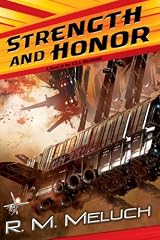
This is the fourth book in a series. Here's the background as laid out in book one, The Myriad. In the not too far future, shortly after humanity begins colonizing the galaxy, the first colony to be founded declares independence and extends an invitation to all true children of Rome. Thousands of scientists, priests, doctors, and lawyers (but not indian chiefs, to my knowledge) drop what they're doing and emigrate. Rome never truly fell, you see. It just went underground, keeping itself clandestinely alive in those vocations and professions where Latin is spoken. A state of war develops between the United States and the rogue colony and things are spiraling downward until the discovery of a hive-like alien lifeform that eats anything organic forces the warring parties into an uneasy truce.

Over the first three books, we follow Captain John Faragut (of the Kentucky Faraguts) and the crew of the U.S. space battleship Merrimack as they fight the Romans, fight the Hive, fight (by which I mean outwit) the bureaucratic nitwits of the United Nations, fight the Hive some more, and in some cases fight their attraction to fellow servicemembers of the opposite sex. We also meet Augustus, a Roman patterner (think Frankenstein's monster with an implanted supercomputer) given to Faragut by Caesar to help (or possibly spy on) the Merrimack in its alien-fighting tasks. All in all, it's great brain-candy, full of little details (like hand-to-tentacle fighting against the hive gorgons by marines wielding swords because the gorgons emit a field that causes most technology to fail) that make the story a rip-roaring space opera of the highest caliber. There's even a giant pulsating temporal reset button in the first book that the author gets to press.

Then we get to book four. Since the end of the third book, it looks like it's pretty much all over but the shouting. The Hive appears to be vanquished, and little remains but for Merrimack to make the long journey home from the back end of beyond. Then (new) Caesar declares that since the threat is gone, the war is back on and simultaneously launches a bunch of sneak attacks. Augustus, still loyal to old Caesar (both because of programming and his own natural inclination), escapes and disappears. Merrimack heads for Earth at full speed. Treachery, subterfuge, fighting, insanity, yadda yadda yadda. Book ends.

Can you tell this one left me flat? Without the hive fighting from the previous books, the human-on-human ship battles were kinda cartoonish (in the old G.I. Joe fire a million laser rifles but nobody dies sense) because all the fighters and larger ships have such absurdly overpowered forcefields that they survive anything short of being plunged into the heart of the sun. The villains lack only pencil-thin mustaches to twirl and the heroes in at least a few cases actually do get to wear shining armor. The melodrama dial that was set to a nicely bubbling 7 or 8 in previous books gets cranked up to 11 in this one. The good guys win and get laid, the bad guys lose in horrific ways. It just felt to me that the author was tired of this series and wanted to tie off all the loose plot threads so she could bronze the whole ball of yarn and put it on her mantel.

Maybe I'm being too harsh. I don't know. However, I would have been happier if I'd either stopped when this was still a trilogy or if a much of the plot points in this book had been integrated earlier in the series. I recommend the first three books to those wanting a fun romp. However, I don't recommend Strength and Honor unless you really want to know what happens next or you've run out of other things to read. If you're craving some SFnal Romans, read Jim Butcher's Codex Alera books instead.